Discretization
Points on a curve, in parameter order, joined by straight segments — each point keeping its parameter, each segment keeping its chord deviation and angle deviation. The deviations are proven upper bounds, never estimates: a chord-deviation bound is the largest distance from the curve piece to its chord, an angle-deviation bound the largest angle between the curve's tangent and the chord.
Why proven bounds
A uniform parameter grid is not uniform on the curve — on an ellipse the chords bunch at the major-axis ends and stretch at the sides, and the error differs by a factor of 2.4. Discretization inverts the problem: give the allowed deviation, get the points that hold it.
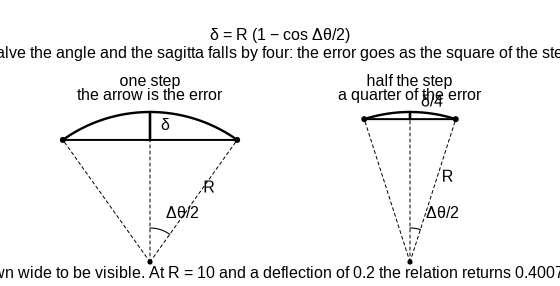
Circles use exact deviations; B-splines split per knot span and bound each span from its Bézier control points (homogeneous form when rational, reporting π where no bound exists — next to a cusp or (nearly) coincident poles). Ellipses, trimmed lines/parabolas/ hyperbolas and run-time curves use exact closed-form deviations of equal parameter steps; a trimmed line is one segment. Closed curves end on their first point, with at least three segments.
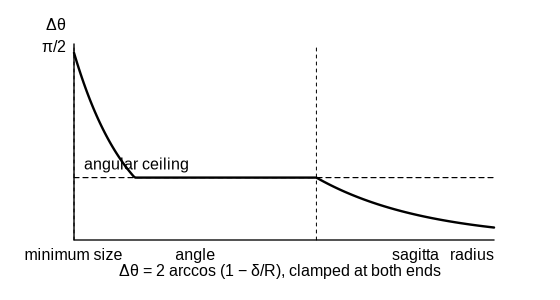
Use
Any positive chord deviation is accepted, including below the
confusion tolerance (points cannot lie closer than coordinate rounding,
about 1e-15 of the curve's distance from the origin). point_count
sizes a caller-owned buffer first; discretize_into fills it without
allocating.
from geomcore import Ellipse, Point, Vector

curve = Ellipse(Point(0, 0, 0), Vector(0, 0, 1), Vector(1, 0, 0), 3.0, 2.0)
d = curve.discretize(0.01)                    # chord deviation ≤ 0.01
d = curve.discretize(0.01, 0.05)              # ... and angle deviation ≤ 0.05 rad
params, points = d.parameters, d.points
chord, angle = d.chord_deviations, d.angle_deviations
use geomcore::prelude::*;
use geomcore::DiscretizationCriteria;

let criteria = DiscretizationCriteria::new(0.01).unwrap();
let n = curve.point_count(criteria);
let d = curve.discretize(criteria);
assert_eq!(d.points[0], curve.point_at(curve.bounds().0));
In the plane, Discretize2D gives a Discretization2D of a
Circle2D, a BSplineCurve2D or a trimmed 2D curve, its chord deviations measured in the
plane. For surface meshing these curves are the edges first — faces
triangulate after their boundary is fixed.