Projection & containment
Three questions, one distance: is the point on the shape
(contains), where is the nearest point (project_point), and
where are all the local minima (extrema). Every query takes a
Tolerance and decides by distance against tol.confusion. Adapted
from Inversion and projection.
In Rust the curve queries are methods of the PointExtrema and
PointExtrema2D traits, built on extrema, and the surface queries
methods of ParametricSurface; use geomcore::prelude::* brings them
all into scope. parameter_of(point, tol) (parameters_of on a
surface) is the inverse of point_at for a point on the shape: the
projection's parameter by default, a closed form on the elementary
geometries.
The foot-point condition
A foot point is where the curve meets its own tangent at a right angle
— the distance is stationary exactly where \((C(u) - P) \cdot C'(u) =
0\). On the ten elementary geometries this
stationarity equation has a closed form (quartic/cubic on the conics,
an atan2 on the rest), so projection is exact. On B-splines there is
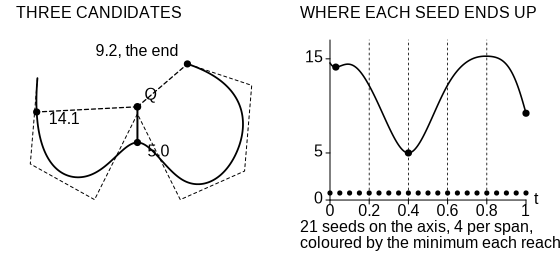
no closed form: the kernel subdivides Bézier pieces with a bounding-box
hierarchy and solves each convex piece with bounded Newton — every
minimum found, however close two basins sit.
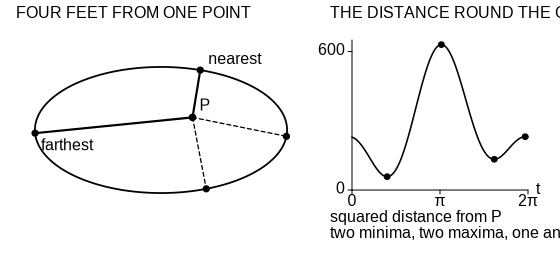
An ellipse already shows why extrema (all minima) and
project_point (the nearest) are different calls: a single point can
have four feet, and the nearest is only one of them. Computed live
below — extrema on a 3×2 ellipse from a near-centre query, four feet:
contains
A point lies on a curve or surface when it is within tol.confusion
of it, tested by re-evaluating the inverse parameter — never by
pointer or topology.
The Python examples on this page share these shapes:
import numpy
from geomcore import Circle, Ellipse, Line, Point, Sphere, Vector

circle = Circle(Point(0, 0, 0), Vector.unit_z(), 2.0)
sphere = Sphere(Point(0, 0, 0), 2.0)
ellipse = Ellipse(Point(0, 0, 0), Vector.unit_z(), Vector.unit_x(), 3.0, 2.0)
line = Line(Point(0, 0, 3), Vector.unit_x())
us = numpy.linspace(0.0, 6.0, 7)
vs = numpy.linspace(-1.0, 1.0, 7)
circle.contains(Point(2, 0, 0))          # True, on the radius-2 circle
sphere.contains(Point(0, 0, 2.01))       # False, off the surface
use geomcore::prelude::*;
use geomcore::Tolerance;

let tol = Tolerance::DEFAULT;
assert!(circle.contains(Point::new(2.0, 0.0, 0.0), tol));
assert!(!sphere.contains(Point::new(0.0, 0.0, 2.01), tol));
project_point
Returns the closest point: its parameter(s), the point itself and the
distance. A distance within tol.confusion snaps to 0.0, so projection
agrees with contains: with the default tolerance (confusion 1e-7) a
point 1e-8 off a cylinder projects at distance 0.0, and one 1e-7 off
at its measured distance. Pass a smaller Tolerance to read smaller
distances. In Python the result is a CurveProjection,
CurveProjection2D or SurfaceProjection that also holds the target
it was computed on and the query_point. Batch variants
(project_points) share the setup and return a list.
foot = circle.project_point(Point(3, 0, 0))
foot.parameter, foot.point, foot.distance, foot.target is circle
sfoot = sphere.project_point(Point(0, 0, 5))
sfoot.u, sfoot.v, sfoot.point, sfoot.distance
let foot = circle.project_point(Point::new(3.0, 0.0, 0.0), tol);
assert_eq!((foot.parameter, foot.distance), (0.0, 1.0));
assert_eq!(foot.point, Point::new(2.0, 0.0, 0.0));

let sfoot = sphere.project_point(Point::new(0.0, 0.0, 5.0), tol);
extrema
All local minima of the distance, nearest first, and nothing else: a
farthest point is never listed, and an end of a bounded curve only
where the distance grows from it into the curve. What project_point
returns first, extrema returns whole.
minima = ellipse.extrema(Point(4, 1, 0)) # [CurveProjection, ...] nearest first
let minima = ellipse.extrema(Point::new(4.0, 1.0, 0.0), tol);
On seams the parameters are normalised into bounds(); a hit within
confusion of the seam reports 0 whichever side it was found from, so
callers can test results against bounds() and trimmed ranges without
losing hits.
Many points at once
In Python, project_points_array takes an (N, 3) array-like ((N, 2)
for a planar curve) and returns numpy arrays instead of one projection
object per point; points_at_array does the same for evaluation. The
computation runs with the interpreter lock released, and numpy is
imported only when these are called (pip install geomcore[numpy]).
import numpy

queries = numpy.random.default_rng(0).normal(size=(100_000, 3))
parameters, points, distances = circle.project_points_array(queries)
# parameters (N,), points (N, 3), distances (N,); a surface gives (N, 2) parameters
grid = sphere.points_at_array(numpy.column_stack([us, vs]))   # (N, 3)
Curves against curves
curve.extrema(other) with another curve reports the local minima of
the distance between the two curves over their domains: the primitive
behind closest-approach queries and trimmed-arc handling. With a point,
the same method gives that point's projections, as above. In Rust the
curve pair is the free function curve_curve_extrema (ADR 0033).
minima = line.extrema(circle).minima
distances = [m.distance for m in minima]
use geomcore::curve_curve_extrema;

let minima = curve_curve_extrema(&line, &circle, tol);
let closest = minima.minima().iter().map(|m| m.distance);