Intersection
One entry point, two methods. a.intersect(b) (in Rust,
a.intersect(&b, tol)) works for any two
curves or surfaces, B-splines, Bézier types and trimmed curves
included, in either order. It solves the pair exactly whenever a closed form exists, and
runs a numeric search (curve–curve, curve–surface, marching
surface–surface) otherwise. The result says which method ran and
whether every hit was found, so a switch from nanoseconds to
milliseconds is never hidden. Adapted from
Intersection.
What an intersection returns
One result per family: CurveCurveIntersection (and
CurveCurveIntersection2D, the plane's instance of the same
GenericCurveCurveIntersection), CurveSurfaceIntersection and
SurfaceSurfaceIntersection. Each one carries:
- the hits: the point, the multiplicity (1 for a crossing, 2+ for a tangency) and the parameters on both operands, always filled: where a closed form solves for one operand's parameter only, the other's is recovered in closed form from the point. Hits are sorted by the first operand's parameter;
- the overlaps, where a curve lies on the other shape: a parameter
range on each curve plus
same_direction, or the curve's ranges on a surface; - for two surfaces, the curves (each with a
tangentflag and its curve in the parameters of each surface, see below), the contact points and whether the surfaces are coincident; - the method (
EXACTorNUMERIC;ExactorNumericin Rust) and the completeness: an exact result is always complete; a numeric one is complete, incomplete (with the regions where hits may be missing) or sampled. The method says how the result was found, not what type its curves are: an exactCirclecan come out of a numeric search, as on the swept surfaces below. Nor doesEXACTmean that every curve is the closed form itself: a loop of two quadrics that is no conic, as two cylinders crossing, is a B-spline fitted through the closed form, within the confusion of both surfaces. Each curve'sdeviationtells them apart:0.0for a closed-form curve, the largest distance found from the surfaces for a fitted one.
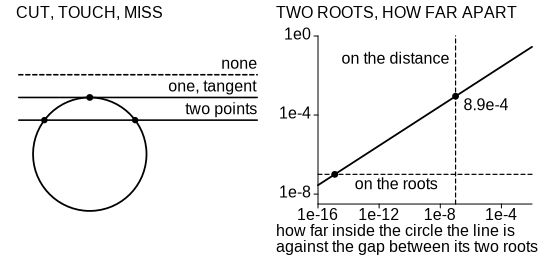
Hits on circles and ellipses keep their parameters inside bounds(),
and a tangency is decided by distance, not by root separation:
Exact: one call, either order
The Python examples on this page share these shapes:
from geomcore import BSplineCurve, BSplineSurface, Line, Plane, Point, Sphere, Vector

plane = Plane(Point(0.0, 0.0, 0.0), Vector.unit_z())
sphere = Sphere(Point(0.0, 0.0, 0.5), 1.0)
line = Line(Point(-2.0, 0.0, 0.5), Vector.unit_x())

# A dome over the unit square, a curve diving through it, and a second
# curve through the first one's middle.
dome = [
    [Point(x, y, 1.0 if x == y == 0.5 else 0.0) for y in (0.0, 0.5, 1.0)]
    for x in (0.0, 0.5, 1.0)
]
spline_surface = BSplineSurface(2, 2, dome, [0.0, 1.0], [3, 3], [0.0, 1.0], [3, 3], False, False)
spline_curve = BSplineCurve.interpolate(
    [Point(0.1, 0.2, 1.0), Point(0.4, 0.5, -0.5), Point(0.7, 0.4, 1.0), Point(0.9, 0.8, -0.5)], 3
)
curve_a = spline_curve
curve_b = BSplineCurve.interpolate(
    [Point(0.0, 0.5, 0.0), curve_a.point_at(0.5), Point(1.0, 0.0, 0.5)], 2
)
surface_a = spline_surface
surface_b = Plane(Point(0.0, 0.0, 0.25), Vector(0.0, 0.2, 1.0))
result = plane.intersect(sphere)    # SurfaceSurfaceIntersection
circle = result.curves[0].curve     # Circle
hits = line.intersect(sphere).hits  # [CurveSurfaceHit], in either order
use geomcore::prelude::*;
use geomcore::{IntersectionMethod, Tolerance};

let tol = Tolerance::DEFAULT;
let result = plane.intersect(&sphere, tol);
assert_eq!(result.method(), IntersectionMethod::Exact);
assert_eq!(sphere.intersect(&plane, tol), result);
In Rust, a pair of concrete types calls its exact solver directly, with
no run-time dispatch; only Curve, Surface, ElementaryCurve or
ElementarySurface operands pay for a match. For hot loops over a
pair of concrete types, a.intersect_exact(&b, tol) (the IntersectExact
trait, Rust only) returns the pair's own enum, such as PlaneSphereIntersection,
on the stack, recovers no parameter it does not need, and reports
NotAnalytic where no closed form exists instead of searching.
Covered pairs include plane/quadric/torus surfaces against each other
in their symmetric configurations — among them the tee of two equal
cylinders whose axes meet, two ellipses that cross at the two points
where the cylinders touch, both listed in contact_points — and any two
cylinders whose axes cross, a sphere and a cylinder or a cone whose
axis misses its centre, a cone and a cylinder off its axis, or two
cones in general position. Those meet in a quartic, in one loop or two:
the bicylindric curve of two cylinders, or, for a sphere, Viviani's
curve among others. Where a generator of one cone runs along one of the
other's, the curve runs off to infinity there: each piece between two
such generators comes back whole as an exact QuarticBranch, unbounded
both ways, the loops that stay bounded fitted as usual. A cylinder whose
axis runs along a generator of a cone meets it once on each of its own
generators, on one loop that is bounded, or runs off to infinity in
branches like those. A cone and a cylinder, or two cones, that touch
at a point meet in a curve crossing itself there, one loop through the
point twice, or at that point alone; so does a cone whose apex lies on
the other surface, at its apex. Where each apex of two cones lies on
the other, the line through both lies on both, and the rest is a cubic
through both apexes: intersect returns the line and the cubic's
pieces between its points at infinity as QuarticBranch curves, with
both apexes as contact points. So does a cylinder along a generator of
a cone through its apex: that generator and a cubic through the apex,
in one branch, the apex the contact point. Surfaces that touch twice
and meet nowhere else, such as a pipe beside a cone's apex touching
both nappes, give those two points as contact_points.
intersect_exact returns its closed form
(QuarticCurve, exact points on both surfaces), and intersect fits
each loop within confusion and reports the result exact and complete,
with the point where the surfaces touch, if any, in contact_points:
two cylinders with axes |r1 − r2| apart meet in one loop that crosses
itself there. Two cones with one apex and axes apart split into lines
instead: up to four through the apex, the generators they share, with the apex in
contact_points. A cone and a cylinder, or two cones, whose axes meet
at a point as far from both, so that both touch one sphere centred
there, split into two plane conics (the ellipses of a reducer), with the
points where they touch in contact_points. Two cones with parallel
axes and equal half-angles, each the other moved sideways, meet in one
plane conic: the hyperbola of two neighbouring chamfers.
A torus meets a plane or a sphere in any position in closed form too,
read along its tube circles instead of a quadric's generators. A plane
cuts a spiric section: two loops around the axis, one loop or two
(Cassini's ovals, parallel to the axis at the minor radius from it), or
one crossing itself where the plane touches the inside of the tube, that
point in contact_points. A sphere off the axis meets it in a quartic of the
same shapes. A sphere touching it twice meets it in two circles through
both points, and one centred in the torus's plane can hold two tube
circles. A plane or a sphere that touches the torus and meets it nowhere
else gives that point. A horn or spindle torus, whose tube circles cross
on its axis, runs the numeric search away from the special positions.
A cylinder or a cone off the torus's axis meets it in a curve of degree
eight, an OcticCurve, read along the same tube circles: each holds up
to four of its points, the roots of a quartic. A pipe through the tube
cuts two loops, one along a diameter four, and one touching the torus
crosses itself there, that point in contact_points, as does a cone
whose apex lies on the torus. One touching it and meeting it nowhere
else gives that point. A horn or spindle torus, or a cylinder or a cone
holding a tube circle, runs the numeric search.
Two tori off one axis meet in an OcticCurve too, read along the first
one's tube circles: two loops for rings linked like a chain, loops
crossing where tori side by side touch, a point where they touch and
part. Pipe bends joined end to end share a tube circle and touch all
along it: it comes back as a tangent curve (OcticCurve::shared_circle),
with the loops of the rest of the curve. A circle of one torus lying on
the other otherwise, a latitude or Villarceau circle, comes back as one
of the loops, the rest of the curve crossing it, in either order: where
a tube circle of the first torus lies on the second, the pair is read
along the second's tube circles instead.
Lines/circles/conics against each
other and against the elementary surfaces, except an ellipse, a
parabola or a hyperbola against a torus: substituted into the torus they
give an equation of degree 8, and that pair runs the numeric search. A
circle against a torus gives one of degree 4, the torus being
bicircular: up to four hits, or the whole circle where it lies on the
torus (a tube, latitude or Villarceau circle). Any two conics —
coplanar (up to four hits) or in crossing planes (met on the shared
line). The 2D pairs are exact too: any two of Line2D, Circle2D,
Ellipse2D, Parabola2D and Hyperbola2D, whole or trimmed, solved
by the coplanar solvers with the same tangency multiplicities and
overlaps; only a pair holding a BSplineCurve2D or a BezierCurve2D
runs the numeric search. A Bézier curve or surface is searched as the
B-spline it is.
A plane meets an extrusion or a revolution in closed form in four
positions: generator lines where it holds the extrusion's direction, the
profile carried onto it otherwise, circles where it is perpendicular to
the revolution's axis, and the profile turned into it where it holds the
axis. The curves are exact types, a Line, a Circle or a curve of the
profile's kind. They sit where the profile crosses the plane, though,
and that crossing is exact only for an elementary profile. On a
B-spline or Bézier profile it comes from the numeric curve–plane search,
so a horizontal cut of a spline revolution is a list of Circles with
method Numeric and completeness Complete. A sphere cut by a coaxial cylinder, computed live below —
two exact rings in ~0.4 µs on a Linux x86-64 desktop, single thread:
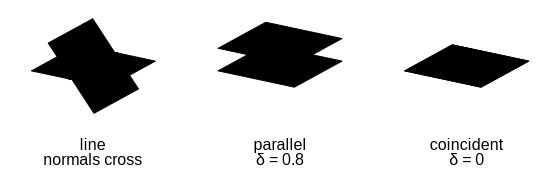
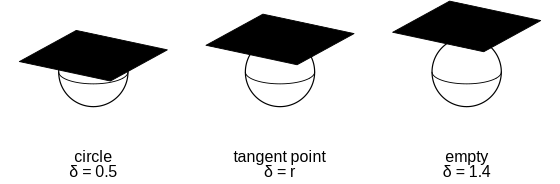
Two more landmarks, as figures:
Numeric: curves
The routed intersect takes the numeric search for pairs
without a closed form (a B-spline, or an ellipse against a torus), and
trimmed pieces are searched over their own range. A curve or surface
type you define yourself, by implementing ParametricCurve or
ParametricSurface, goes through intersect_curve_curve(a, b, tol) and
intersect_curve_surface(curve, surface, tol): they always run the
numeric search and return the same result types as the routed call.
On B-splines there is no sampling grid: Bézier pieces subdivide where their control boxes overlap until each
pair holds at most one hit, then Newton solves it — crossings a grid
would miss between samples are found, and tangencies/overlaps fall
back to the sampled search instead of burning the budget.
Where a curve lies on the other operand (a planar B-spline in a plane, a
straight B-spline on a line, two B-splines along one line, a circle and
its own to_bspline()), the pieces never separate. The hits and regions
left along the curve are then joined into an overlap wherever the
curve stays on the other operand between them (samples within
tol.confusion, tangents along it), extended by halving to where the
curve leaves it, within tol.confusion in space of the true end. The
hits inside drop out, and the result stays Incomplete, with an
Unseparated region over the overlap: samples found it, not a proof.
The reason stays Unseparated where the search ran out of halvings
along a curved overlap, since no budget would separate its pieces; it is
BudgetExhausted only where pieces beside the overlap were left
unsettled. A
stretch where the operands only touch (they part as the square of the
distance from the contact) is one hit at the closest approach, with
multiplicity 2, and the result stays Complete; an overlap between curves whose
range on the second curve would cross that curve's seam is not joined,
and keeps its hits and region.
The search reports whether it finished: the result's method is
Numeric, and its completeness is Complete when every piece pair
was proven apart or isolated, Incomplete with the parameter regions
where hits may be missing otherwise, and Sampled when the hits come
from samples (a pair without a B-spline, such as an ellipse against a
torus). Between two curves the sampled search halves its grid's spans
wherever their chords come within the curves' offset from them, so
crossings closer together than the grid spacing are each found.
result = spline_curve.intersect(spline_surface)  # CurveSurfaceIntersection
for hit in result.hits:
    hit.curve_parameter, hit.u, hit.v, hit.point
complete = result.is_complete()
intersection = curve_a.intersect(curve_b)        # CurveCurveIntersection
use geomcore::prelude::*;

let result = spline.intersect(&surface, tol);
for h in result.hits() {
    let _ = (h.curve_parameter, h.surface_parameters, h.point);
}
let complete = result.is_complete();
let intersection = a.intersect(&b, tol);
Numeric: marching surfaces
For a pair without a closed form, the routed intersect of two
surfaces seeds from the points where iso-curves of an elementary side
(rulings and circles of a cylinder or cone, circles of a sphere or
torus, lines of a plane) meet the other surface exactly, so an
unbounded surface is searched whole. A B-spline side adds its own
seeds, and two bounded surfaces add a parameter grid. It then traces
with curvature-following steps corrected by Newton on both surfaces,
until the trace closes or leaves its box: the smaller bounded side's
box, or, when neither side is bounded, the box of the seeds grown by
the larger surface size. A branch that leaves that seeded box is cut
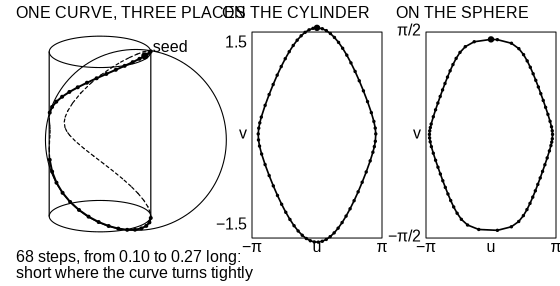
there and reported as unbounded. The trace fits each
loop or arc as a BSplineCurve: where the surfaces cross, cubic
Hermite segments through the traced points and their exact tangents,
each checked at its midpoint, so the whole curve stays within
confusion of both surfaces. Two B-spline surfaces additionally
seed from overlapping patch pairs, so isolated loops smaller than the
seed spacing are found there. A marched result is Sampled: a loop
smaller than the iso-curve spacing can be missed. Two bounded surfaces
whose boxes are apart are proved not to meet: the result is empty and
Complete. The boxes of the control points are checked before the
march, and the tight boxes (see tight_bounding_box) after a march that
found nothing. Where a branch of two
unbounded surfaces was cut at its box, the result is Incomplete with
Unbounded as its reason, and its regions mark where the cuts are.
Where a curve's deviation exceeds the confusion, the result is
Incomplete with LooseFit (LOOSE_FIT in Python), and a region holds
each such curve: it is returned, but lies only within its deviation of
the surfaces. That happens where a surface's parameters degenerate on
the curve (a sphere's pole), where their rounding is coarser than the
confusion, and along a touch.
The confusion also sets the size of a fitted curve: each segment must
stay within it of both surfaces, so a looser confusion takes fewer,
longer segments. The steps never grow past a thousandth of the smaller
surface's size, so a looser confusion finds the same curves. Two wavy
B-spline patches cut at the default 1e-7 give curves of 298 and 198
poles; at 1e-3 the same two curves take 52 and 34 poles. The same
value decides what counts as a hit or a tangency, so loosen it for a
lighter fit only where a point within it of both surfaces is on both. In Python, tol=1e-3 is short for
Tolerance(confusion=1e-3).
# Exact curves (Line, Circle, ...) where a closed form exists,
# BSplineCurve where marched.
result = surface_a.intersect(surface_b)
curves = [piece.curve for piece in result.curves]
use geomcore::prelude::*;

let result = a.intersect(&b, tol);
let curves = result.curves();   // BSpline curves where marched
The parameter of a fitted curve
A fitted curve, marched or fitted from a closed form (a loop where two
cylinders cross), is a cubic BSplineCurve whose parameter is its arc
length, to within the fit: its knots are the lengths of its segments,
each measured as a circular arc between its end tangents, so its speed
stays close to 1 (within 1e-4 on the loops of two crossing cylinders, a
torus and a sphere, and a plane and a B-spline sphere) and a piece's
length is about the length of its range. A fitted closed loop is
periodic, its period its length: a piece of it can run across its start,
as an arc of a circle runs across its seam, and a TrimmedCurve takes
the piece's range. Where the surfaces touch along a marched curve, it is
an interpolant whose parameter runs from 0 to 1, spaced by the square
roots of the distances between the traced points, and a loop is not
periodic.
The curves in each surface's parameters
Each curve also comes as first_uv_curve and second_uv_curve: the
curve in the (u, v) parameters of each surface, in the same parameter
as curve, so the surface's point at the (u, v) of t is the curve's
point at t. A marched curve always has both: the march walked the
parameters of every point it traced, and they are fitted on the curve's
own knots, continuous across the seams (a loop around a cylinder ends a
period away in u). An exact curve has the exact one where a closed
form exists (a circle in a plane's parameters, a ruling or a parallel
circle as a line in a cylinder's) and None otherwise: an ellipse on a
cylinder, a circle of two spheres that is no parallel of either, a
hyperbola of two cones, the ellipses where two equal cylinders cross, and
any curve running through a sphere's pole or a cone's apex, where its
u jumps. A meridian clipped to a trimmed sphere between its poles has
its line again. curve_3d_to_uv_within maps the
others within a deviation.
from geomcore import Cylinder, Plane, Point, Vector

cylinder = Cylinder(Point.origin(), Vector.unit_z(), 1.0)
(piece,) = Plane(Point(0.0, 0.0, 2.0), Vector.unit_z()).intersect(cylinder).curves
on_plane = piece.first_uv_curve       # Circle2D
on_cylinder = piece.second_uv_curve   # Line2D: the iso-line v = 2
uv = on_cylinder.point_at(0.7)
assert cylinder.point_at(uv.x, uv.y).distance(piece.curve.point_at(0.7)) < 1e-12
use geomcore::prelude::*;
use geomcore::{Cylinder, Plane, Point, Tolerance, Vector};

let cylinder = Cylinder::new(Point::ORIGIN, Vector::Z, 1.0).unwrap();
let plane = Plane::new(Point::new(0.0, 0.0, 2.0), Vector::Z).unwrap();
let result = plane.intersect(&cylinder, Tolerance::DEFAULT);
let piece = &result.curves()[0];
let on_cylinder = piece.second_uv_curve.as_ref().unwrap(); // the line v = 2
Before seeding, a surface with bounded parameters is checked for lying
on the other: a 7 × 7 grid of its points, and the centres of the
grid's cells, must lie within confusion of the other surface, with the
normals parallel within the tilt that distance allows between samples
(about twice the confusion over their spacing), so a fitted or slightly
moved copy still counts. Surfaces lying on each
other, such as a sphere and its own to_bspline(), come back coincident
(Sampled, since samples found it). A patch lying on a larger or
unbounded surface, such as a cylinder and its to_bspline_patch, comes
back Incomplete with one Unseparated region covering the patch, and
no curves. Where the surfaces touch along a curve (a plane tangent to a
cylinder patch along a ruling, a sphere inside a cylinder of its radius)
the curve is traced along the direction in which they keep touching and
reported with tangent set; a touch at a point is a contact point,
at a sphere's pole too.
Marching is approximate by design. Its limits:
- the curves are fitted, to about 1e-4 at the default tolerance;
- at a point where a surface has no tangent plane (a cone's apex, a
spindle torus's points on its axis), no trace can step: the branches
leaving it are seeded a first step away, where the other surface
crosses the ring of points around it. A branch along which the
surfaces only touch is kept where the other surface comes within
confusion of that ring. A seed that no trace leaves and no curve
passes through makes the result Incomplete with an Unseparated
region at it, rather than dropping it;
- the coincidence check sees only a whole surface lying on the other:
two patches that overlap in part are marched; the seeds where they lie
on each other make the result Incomplete with an Unseparated
region around the overlap, but spurious curves may still cross it;
- where crossing curves touch each other, traces stop rather than turn
onto the other branch;
- a loop that no seeding iso-curve crosses and that leaves no distance
minimum on either grid is missed: a plane cutting a small circle
(radius 0.014) off a B-spline sphere of radius 1 near its equator or
pole comes back Sampled with no curves.
A wavy B-spline patch through a sphere, marched live below — one fitted loop in ~8 ms on the same machine. The loop is an exact B-spline in the scene, so the viewer refines it as you zoom:
Trimmed surfaces
A face lies on a patch of its surface, not the whole of it.
surface.trimmed(u_range, v_range) restricts a surface to a rectangle
of its parameters, a TrimmedSurface; a periodic direction's range may
cross the seam, as (1.5π, 2.5π) on a cylinder. intersect takes it
with any surface or another trimmed surface, in either order: the bases
are intersected, exactly where a closed form exists, and each curve is
cut to the pieces inside the ranges of the trimmed sides. A piece keeps
the curve of the bases, and its parameter_range says which part lies
on both patches; an untrimmed pair's is the curve's own bounds. A
curve cut on both sides of its seam keeps the piece across it whole,
its range running past the period.
import math
from geomcore import Cylinder, Plane, Point, Vector

cylinder = Cylinder(Point.origin(), Vector.unit_z(), 1.0)
half = cylinder.trimmed((0.0, math.pi), (-5.0, 5.0))
plane = Plane(Point.origin(), Vector(0.0, 1.0, 1.0))
(piece,) = plane.intersect(half).curves   # half of the ellipse
start, end = piece.parameter_range
assert math.isclose(end - start, math.pi)
use geomcore::prelude::*;
use geomcore::{Cylinder, Plane, Point, Tolerance, Vector};
use std::f64::consts::PI;

let cylinder = Cylinder::new(Point::ORIGIN, Vector::Z, 1.0).unwrap();
let half = cylinder.trimmed((0.0, PI), (-5.0, 5.0)).unwrap();
let plane = Plane::new(Point::ORIGIN, Vector::new(0.0, 1.0, 1.0)).unwrap();
let result = plane.intersect(&half, Tolerance::DEFAULT);
let (start, end) = result.curves()[0].parameter_range;
assert!((end - start - PI).abs() < 1e-9);
A march between trimmed surfaces is held to the box of the patches, so
two patches of unbounded surfaces whose intersection runs to infinity
and has no closed form come back Sampled with curves ending on the
ranges instead of cut and Incomplete. An exact curve that runs to
infinity, a line or a QuarticBranch, is cut where it leaves the
ranges, and the result stays exact. Contact points outside the ranges are dropped, and two
patches of one surface are coincident only where they overlap with area.
Two that only touch report where: a shared edge is a tangent curve
with its curves in both patches' parameters, and a shared corner a
contact point. Two faces of one cylinder stacked at height 1 meet along
the circle there:
import math
from geomcore import Cylinder, Point, Vector

cylinder = Cylinder(Point.origin(), Vector.unit_z(), 1.0)
low = cylinder.trimmed((0.0, 2 * math.pi), (0.0, 1.0))
high = cylinder.trimmed((0.0, 2 * math.pi), (1.0, 2.0))
result = low.intersect(high)
assert not result.is_coincident()
(edge,) = result.curves               # the circle at height 1
assert edge.tangent
use geomcore::prelude::*;
use geomcore::{Cylinder, Point, Tolerance, Vector};
use std::f64::consts::TAU;

let cylinder = Cylinder::new(Point::ORIGIN, Vector::Z, 1.0).unwrap();
let low = cylinder.trimmed((0.0, TAU), (0.0, 1.0)).unwrap();
let high = cylinder.trimmed((0.0, TAU), (1.0, 2.0)).unwrap();
let result = low.intersect(&high, Tolerance::DEFAULT);
assert!(!result.is_coincident());
assert_eq!(result.curves().len(), 1); // the circle at height 1
This needs the two bases to parametrize the surface alike, up to shifted, reversed or swapped parameters, as two frames of one cylinder on its axis do; patches of bases parametrized otherwise are still coincident when they only touch (ADR 0039).
A curve meets a trimmed surface, in either order, as it meets the
basis, clipped to the ranges: a hit is kept when its surface parameters
lie in them, and reports them there, so a hit at a cylinder's angle 0
on a face from 3π/2 to 5π/2 reports u = 2π. An overlap, a stretch of
the curve lying on the basis, is cut to its pieces inside the ranges.
Filtering the basis's hits on u_range() by hand would miss that hit,
one period below the range.
import math
from geomcore import Cylinder, Line, Point, Vector

cylinder = Cylinder(Point.origin(), Vector.unit_z(), 1.0)
face = cylinder.trimmed((1.5 * math.pi, 2.5 * math.pi), (0.0, 5.0))
line = Line(Point(-5.0, 0.0, 1.0), Vector.unit_x())
(hit,) = line.intersect(face).hits     # only the side x >= 0
assert math.isclose(hit.u, 2 * math.pi)
use geomcore::prelude::*;
use geomcore::{Cylinder, Line, Point, Tolerance, Vector};
use std::f64::consts::{PI, TAU};

let cylinder = Cylinder::new(Point::ORIGIN, Vector::Z, 1.0).unwrap();
let face = cylinder.trimmed((1.5 * PI, 2.5 * PI), (0.0, 5.0)).unwrap();
let line = Line::new(Point::new(-5.0, 0.0, 1.0), Vector::X).unwrap();
let result = line.intersect(&face, Tolerance::DEFAULT);
assert_eq!(result.hits().len(), 1); // only the side x >= 0
assert!((result.hits()[0].surface_parameters.0 - TAU).abs() < 1e-12);
A face moves with transformed: the basis maps through the transform
and each range with the basis's parametrization, scaled where the
parameter is a length (a cylinder's height) and kept where it is an
angle, so the image holds the image of every point of the face. Moving
the basis and trimming it to the same ranges is wrong under a scaling.
face.trimmed(u_range, v_range) trims a face again, over the part of
each range the new one covers; a periodic direction's range is read
modulo the period.
All the scenes on this page were computed by the kernel itself —
see docs/assets/scenes/gen_scenes.py — not drawn by hand.