Curve on surface
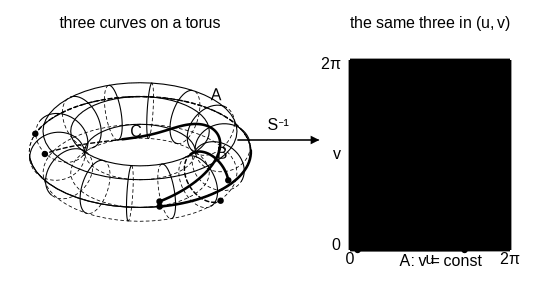
A curve that lies on a surface has an exact 2D image in the surface's
parameter space — the UV curve, also called a pcurve.
surface.curve_3d_to_uv computes it in closed form where one exists
(lines and circles on the five elementary surfaces, any curve on a
plane); curve_3d_to_uv_within gives one B-spline within a deviation
anywhere else. A surface intersection hands over the UV curves of its
curves on both surfaces already (see
Intersection).
Adapted from
Parametric domain.
Why the rectangle matters
Kernels work in \((u, v)\) because the rectangle is flat: offsetting, trimming and marching are all easier there than in space. But a uniform grid in the rectangle is not uniform on the surface — the first fundamental form stretches it — so every downstream algorithm must know what the parameters measure (see Elementary).
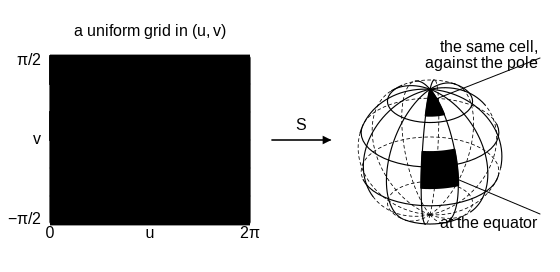
Analytic UV curves
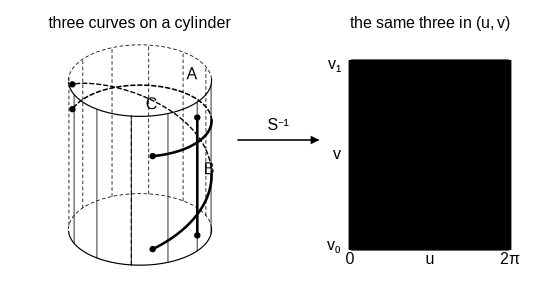
A circle coaxial with a cylinder is a horizontal line in \((u, v)\); a
line in a plane is a line. The result is a Line2D/Circle2D (or a
Curve2D run-time value) that evaluates through the surface back onto
the 3D curve within tol.confusion — that check is what "lies on"
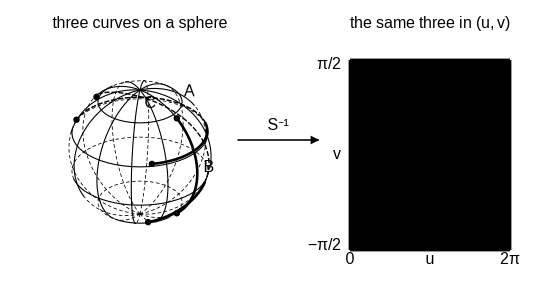
means, and anything farther off is CurveNotOnSurface. A sphere's
meridian runs through both poles, where its u jumps by half a turn, so
no line within the v bounds holds the whole circle: it is refused as
ThroughPole, and an arc of it from pole to pole maps to a line along
v (trimmed_curve_3d_to_uv in Rust, a TrimmedCurve in Python).
The Python examples on this page share these shapes: a cylinder, a circle around its axis, and the ellipse a slanted plane cuts from it.
from geomcore import Circle, Cylinder, Plane, Point, Vector

cylinder = Cylinder(Point(0, 0, 0), Vector.unit_z(), 2.0)
circle = Circle(Point(0, 0, 1), Vector.unit_z(), 2.0)
surface = cylinder
(cut,) = Plane(Point(0, 0, 0), Vector(0.0, 1.0, 2.0)).intersect(cylinder).curves
curve = cut.curve                                # an Ellipse on the cylinder
uv_curve = cylinder.curve_3d_to_uv(circle) # Line2D in (u, v)
let uv_curve = cylinder.curve_3d_to_uv(&circle.into(), tol).unwrap();
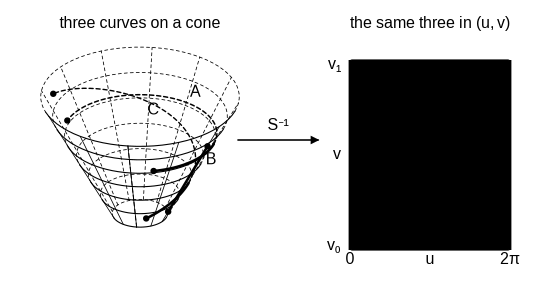
A few images across the surfaces:
Within a deviation
Where no closed form exists, curve_3d_to_uv_within gives one UV curve:
a degree-5 B-spline in the 3D curve's own parameter, whose image on the
surface lies within the asked deviation of the 3D curve at the same
parameter. It does not jump at a seam: a curve that goes once around a
cylinder ends one period of u from where it starts. It mirrors
uv_curve_to_3d_within. A curve that starts or ends at a sphere's pole
or a cone's apex, where every u is the same point, takes the limit of
u from inside the curve: a meridian keeps its own u up to the pole.
In Python both are surface methods, beside the exact curve_3d_to_uv
and uv_curve_to_3d: surface.curve_3d_to_uv_within(curve, d) and
surface.uv_curve_to_3d_within(uv_curve, d). In Rust they are the
generic free functions curve_3d_to_uv_within(&surface, &curve, d, tol)
and uv_curve_to_3d_within(&surface, &uv_curve, d, tol).
approximation = surface.curve_3d_to_uv_within(curve, 1e-6)
uv_curve = approximation.curve        # BSplineCurve2D
approximation.deviation               # <= 1e-6
approximation.is_proven()             # False: sampled
use geomcore::curve_3d_to_uv_within;

let approximation = curve_3d_to_uv_within(&surface, &curve, 1e-6, tol)?;
let uv_curve = approximation.curve();
Recipe: a helix
A helix is a straight line in the UV space of a cylinder: one turn is
2π in u and one pitch in v. uv_curve_to_3d_within turns that line
into one B-spline within the deviation, so a helix needs no type of its
own:
import math

from geomcore import Cylinder, Line2D, Point, Point2D, TrimmedCurve2D, Vector, Vector2D

radius, pitch, turns = 5.0, 2.0, 3.0
cylinder = Cylinder(Point.origin(), Vector.unit_z(), radius)
# The line's parameter is its length in the UV plane.
uv_line = Line2D(Point2D(0.0, 0.0), Vector2D(2 * math.pi, pitch))
uv_piece = TrimmedCurve2D(uv_line, 0.0, turns * math.hypot(2 * math.pi, pitch))
approximation = cylinder.uv_curve_to_3d_within(uv_piece, 1e-6)
helix = approximation.curve  # degree 9, 60 poles
approximation.is_proven()  # True: within 4.2e-7, proven
helix.end_point()  # Point(5.0, ~0, 6.0): three turns up
A negative u direction turns the other way, a left-handed helix. The
B-spline is an approximation; a caller that needs the exact curve, for
its exact length or projection, would need a Helix type of its own.
Viewing UV curves
The viewer draws a UV curve twice: on the surface in 3D and in its own \((u, v)\) pane. Pass the 2D curve with the already-added surface's handle.
import geomcore_viewer as gv

view = gv.Viewer("A circle on a cylinder")
s = view.add(cylinder, label="S")
view.add(circle, label="C")
view.pcurve(cylinder.curve_3d_to_uv(circle), s, label="C in (u, v)")
use geomcore_viewer::{Geom, Opts};

let s = view.add(Geom::from(&cylinder), Opts::new().label("S"))?;
view.add(&circle, Opts::new().label("C"))?;
view.pcurve(&cylinder.curve_3d_to_uv(&circle.into(), tol)?, &s, Opts::new().label("C in (u, v)"))?;